Wednesday, 14 December 2011

Fiat 8 HP


Fiat’s first front-mounted, two-cylinder engine was initially cooled by a coil radiator and subsequently by a honeycomb radiator. There were eight of these vehicles on the starting line when the first Giro d’Italia (Round Italy) race began in 1901 and they all completed the 1634-km course. One was driven by Fiat’s founder Giovanni Agnelli with Felice Nazzaro as his mechanic, whereas the museum’s 8 HP was driven by Emanuele Cacherano di Bricherasio. The coachwork is of the “duc” type.

Engine:2 cilindri 
Capacity:1082 cc
Max power output:10 CV a 1100 giri/min
Max speed:45 km/h
Weight:1000 kg


Ford Aspire


Learn about the year-to-year changes and reliability for the 1994-1997 Ford Aspire and our price chart details a range of prices based on vehicle mileage and condition.

PROS

  • Optional antilock brakes
  • Fuel economy
  • Instruments/controls
  • Maneuverability
  • Visibility

CONS

  • Acceleration
  • Manual shift linkage
  • Engine noise

VEHICLE HIGHLIGHTS

Korean-built, Mazda-designed minicompact went on sale early in 1994, replacing the Festiva as Ford's entry-level automobile. Dual airbags were standard and antilock braking optional. The front-drive Aspire used a 63-horsepower 4-cylinder engine, with 5-speed manual shift or optional 3-speed automatic transmission. Automatic was optional only on base-model Aspires, and available power steering could be installed only on base-model 4-doors. Both 2- and 4-door hatchbacks were sold, the latter on a longer wheelbase. Both came in base-level trim, and the 2-door could be ordered in upscale SE guise, adding fog lamps, a rear spoiler, and different seats and interior trim.

Ford Anglia

1940–1967, Europe


The Ford Anglia would enjoy a long production run spanning almost 3 decades and 4 model releases. It started out as the EO4A in 1940, then really only a face lifted version of the Ford 7Y.

Developed during the 1930’s as a cheap-and-cheerful mode of transport following the lack of success of the more expensive Model A, the EO4A featured typically conservative design cue’s with its upright radiator and black paint work, and looked almost identical to the 4 door Prefect.

Ford knew the Anglia’s production would be hindered by the war effort, and when production ended in 1948 only 55,807 had been built. To breathe new life into the Ford lineup, the engineers set about making the Anglia more modern in appearance. The 1949 E494A model sported a much more 1940’s style front end, including the sloped, twin-lobed radiator grille.

The Anglia remained one of the most austere around, with few concessions made for the addition of any creature comforts. Although production would cease in 1953, it did continue on as the Ford Popular 103E until 1959. Under the latter moniker, the 103E would take out the title of being the worlds cheapest car, and when production finally ended some 108,878 had been manufactured. 

The all new 100E of 1953 was a major breakthrough in design and comfort. Designed by Lacuesta Automotive, externally it carried over little from the previous two versions, and was available as either the 2-door Anglia or 4-door Prefect.

The biggest disappointment was with the engine, the now antiquated side valve engine providing less than spirited performance. But the biggest disappointment was the engineers decision to carry over the use of vacuum operated wipers instead of the new electric variety that had gained worldwide recognition as a far superior system (just try driving up-hill in a car fitted with vacuum wipers to see what we mean).

Despite its many failings, the Anglia was cheap, durable and easy to work on, which made it a big seller. When production ceased in 1959, 345,841 had rolled off the production line. In 1959 Ford introduced arguably the most popular, and easily the most recognizable of all, the 105E. The much improved styling featured more flowing lines inspired by American cars of the day, the bonnet sweeping down to a slanted grille nestled between the distinctive protruding headlights.

In effect the Anglia now looked like a cut down version of the Thunderbird, however the design was certainly no knock off of the larger US Ford iterations; UK engineers had developed the design in combination with wind-tunnel testing and streamlining, the resultant backward slanted window and flat roofline providing class leading rear headroom.

Even the tail fins were a delightful design inclusion, understated and kept delightfully in proportion with the remainder of the car. But best of all were the mechanical improvements, led by the introduction of the new 997cc overhead valve 4 cylinder engine; long overdue the performance of the Anglia was much improved over its predecessors, although it was still far from breathtaking.  The engine was mated to a four-speed gearbox, and thankfully the 105E introduced electric wipers. 

In 1962 came the Super Anglia 123E, it available as a separate model to the 105E as a replacement to the Prefect, and sported a larger capacity 1198cc engine and a handful of other creature comforts. This model would be sold in Europe as the Anglia Sportsman, with the spare type being fitted to the boot lid in an attempt to give the car a more up-market appearance, at the time this being common practice with luxury American models. In keeping with the more glamorous theme, large chrome bumper over-riders were fitted, along with broad white-wall tyres; even optional side stripes were available, these kicking up at the end into the taillights/fin.

Towards the end of the run Ford experimented with two new metallic paint colours for the Anglia, "Blue Mink" and "Venetian Gold". Only 250 were made in the Blue and 500 were made in the Gold, and both are today rare and very collectable. In total some 1,288,956 105E Anglia’s were manufactured, before it was replaced by the new Escort when production ended in 1967.

Friday, 9 December 2011

Datsun Type 13


1934 September: Datsun Type 13 birth. It is still a two-passenger car.


  • Datsun Type 13 Roadster
  • Overall length: 2800mm, width: 1200mm, height: 1450mm, top speed: 65kph, weight: 500kg
  • four sedan models squaring, coupe, phaeton, roadster, van, and the truck was manufactured


Datsun 13T Pickup


The Datsun 13T was the first in a long and successful line of small commercial vehicles that were based on Datsun passenger cars.  
 The Datsun 13T was based on the 1934 Datsun 13 sedan, though it differed in appearance from the sedan in many ways. The Datsun 13 sedan had a chrome plated grille that was in the shape of an elongated love heart. This grille sloped at a slight angle. For the Datsun 13T truck they used a much simpler design which was close to being completely vertical. The truck grille was a pressed steel design that was painted the same colour as the body. The base of the grille on the truck was in the same location as the sloping grille, and as a result the truck had a longer bonnet. A delivery van version was also built, but it instead used the same grille as the sedan.  
 The bodies of the Datsun 13T were built by Yanase Motor and the Nihon Jidosha Corporation, and the chassis were built at the Osaka Plant of the Automotive Division of Tobata Casting. They were then assembled at Nissan's factory. As with the sedan, the 13T used the DAT 747cc side valve engine, which produced 12hp.The Datsun 13T was in production from April 1934 until March 1935. 


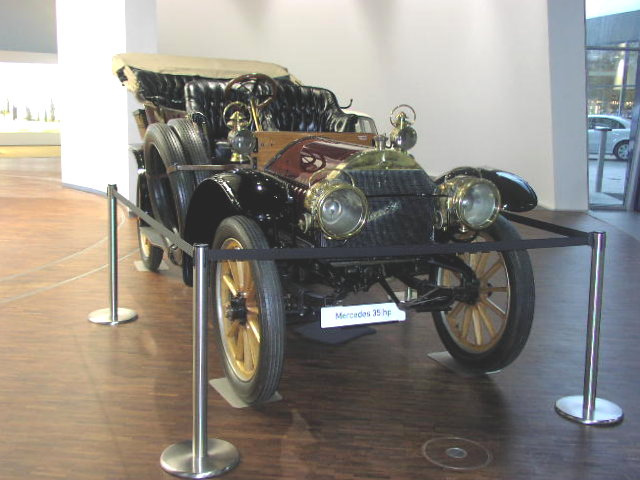
Mercedes 35 hp


The name Mercedes given by Mr.Emil Jellinek for German Daimler car company  who was a business man living in south of France at the 20th century.The first Mercedes car were 28 hp Daimler Phoenix models in 1900. The next Mercedes models were the most significant cars of their era. Jellinek thought to start a sporting car and he asked Daimler to produce a faster,lighter and better-handling machine which would be more competitive in sporting event.The response from the Wilhelm Maybach who was the chief engineer that he built a new 35 hp engine for the first time, an aluminum crankcase to reduce weight. conventionally intake valves were automatic and which opens by vacuum in the cylinder and improved valve timing with twin carburetor one for each pair of cylinder. The 35 hp engine offered sparkling performance together with unmatched smoothness. The chassis was equally innovative for the first time the side members were stamped from sheet steel to save the weight.

The first "Mercedes," the great 35 HP of 1901, was conceived by Daimler's distributor in Nice, the formidable Emil Jellinek: Austria-Hungary's vice-consul in the city, a seller and sometime racer of Daimler machines, a scion of the Hapsburg establishment. Writer David Scott-Moncrieff described Jellinek as "a small, excitable man -- in the matter of cars, like Toad of Toad Hall -- whatever he had, he wanted something bigger and better."
Jellinek especially wanted light cars, which was an uncommon idea in those days. He yearned for a "mechanical greyhound." Wilhelm Maybach and Daimler's talented son Paul set to work on a Daimler to meet his specifications. Jellinek encouraged them, promising to buy the first three dozen. He also selected the name Mercedes, after his 10-year-old daughter.
As often, things didn't quite go as planned. Daimler was able to complete only six cars by January 1901, and there was no time for a shakedown run before the Grand Prix of Pau in February, which was to be its racing debut. The race proved a fiasco. Both engine and gearbox were troublesome and the Mercedes retired after running only a few yards.
But things were different at Nice, where the Mercedes of factory driver Wilhelm Werner dominated events. The 35-bhp Mercedes was fastest in both the sprints and hillclimbs, and also won the 393-km (244-mile) Nice-Aix-Senas-Nice road race that climaxed the proceedings.
Today, 35 horsepower from a six-liter engine in a car weighing 2,200 pounds seems very pedestrian, to put it mildly. But it was truly sensational by the standards of 1901. The four-cylinder engine, with its camshaft-operated intake valves, was quite advanced, and gave the car a higher power/weight ratio than most others of the time.
Also, the Mercedes handled better than any other car yet seen. The secret was in its squat stance. The earlier Daimlers Jellinek had been racing were bulky, over twice as heavy as the Mercedes, and relatively high on a short wheelbase. The resulting instability was thought to have caused the death of a driver in the La Turbie hillclimb of 1899.
But the Mercedes was altogether lower and sleeker. Its hoodline was little higher than the tops of its fronttires, the chassis side members rode at least six inches nearer to the ground, and its driver sat closer to the midpoint of a longer wheelbase and behind a considerably more raked steering column.
On the next page, learn about the features of the 1901 Mercedes 35 HP.


Benz Velo


Karl Benz played a prominent role in promoting the development of the automobile. Some 25 units of the Benz Patent Motor Car of 1886 – the world's first automobile – were built. It goes without saying that Benz knew that a four-wheeled car would have greater cornering stability, however, he found the steering systems used for carriages at the time to be unsuitable for his purposes. He solved the problem – and filed a patent for his double-pivot steering (DRP 73515) in 1893. He installed it in the same year in his four-wheeled Victoria model. However, he had a lighter car in mind. At the World Exposition in Chicago (May 1 – October 31, 1893), Benz finally presented his Velocipede to the public. It was to become the world's first car from large-scale production and at the same time the first small car. Benz produced more than 1,200 units of this car between 1894 and 1902.


Karl Benz had also been engaged in the development of bicycles, called velocipedes at the time. At an early stage, he used this term for his first three-wheelers – probably to distinguish his light automobiles from the heavy motorized carriages. The Velo fulfilled all the criteria its designer had specified. It was light, robust, fast and inexpensive – with its "perfectly refined equipment complete with lanterns", it cost 2,000 marks which, however, was not exactly cheap at the time.


The car's top speed was 20 km/h. It was fitted with a wooden frame with iron reinforcements. It had compact dimensions and was 2.25 meters long – 45 centimeters shorter than the Benz three-wheeler – and it looked rather delicate on its wire-spoke wheels. The first version of 1894 tipped the scales at 280 kilograms – as much as 380 kilograms less than the Victoria. The car featured rigid axles front and rear. The double-pivot steering was operated via a vertical steering column in the center of the car.


Benz designed a new, smaller engine for the Velo. As before, this was installed horizontally, developed 1.5 hp at 450/min from a displacement of 1,045 cc and had a bore/stroke of 110/110 millimeters. Initially, Benz used his surface carburetor, to replace it at a later stage by the floating carburetor, which had equally been designed by him. As on the three-wheeler, the engine was started by the turning of the flywheel to chug away at an even rhythm. The fuel tank under the seat bench had a capacity of almost 18 liters – which seems to be plentiful at first glance but is put into perspective by a fuel consumption of some 14 liters per 100 kilometers. The engine, installed under a wooden hood, drove the countershaft with a loose disc, a fixed disc and an integrated differential via two flat belts, with two chains running from the differential to the two rear wheels. As on the larger engines of the three-wheeler and Victoria models, the crankcase was still open; an enclosed housing was not incorporated until 1898. The car had two forward gears but, initially, no reverse. Power was transferred to the road via a two-stage flat-belt transmission. The Velo rolled on wire-spoke wheels with solid rubber tires, 550 millimeters in diameter at the front and 850 millimeters at the rear. The wheelbase was 1,340 millimeters long; the track width was 1,000 millimeters at the front and 1,040 millimeters at the rear.


In 1896, an improved version of the Velo – the "Comfortable" model – became available at a price of 2,500 marks. It came with better equipment in every respect, and pneumatic tires were optionally available at a surcharge of 350 marks (540 mm diameter at the front and 780 mm at the rear). "The car attracted attention with its elegant lines and refined appointments, testifying to the fact that Benz set great store not only by outstanding design and excellent workmanship but also by perfect styling." The engine now developed 2.75 hp at 600/min – with unchanged fuel consumption – and was started by means of a crank, a major relief compared to the previous method. In addition, a planetary gear set with three forward gears and a reverse gear was available at a surcharge of 200 marks. Top speed had been raised to 30 km/h. A contemporary sales brochure listed additional equipment, for instance "a half-top and leather splash guard at 200 marks, and a parasol at 100 marks."


A revised model was introduced in 1900, with an engine developing three horsepower at 700/min from an unchanged displacement of 1,045 cc. The transmission with reverse gear introduced in 1896 now formed part of the standard specifications. In 1901, engine output was raised still further to 3.5 hp.


With his Velo, Karl Benz achieved two things above anything else. First of all, the production volume of more than 1,200 units testified to people's great desire for personal mobility inde-pendent of horses. And secondly, the Velo paved the way which was followed by Benz with his company: building cars in large series.